En esta sección
Devices
HioPOS Cloud can work with different external hardware devices. These are: Ticket printer, Cash drawer, Scanner, Display, Label printer, Scale, and Card reader.

They can be configured from the option Devices in the Settings menu.
Below are detailed the main technical specifications of the configuration of the Devices.
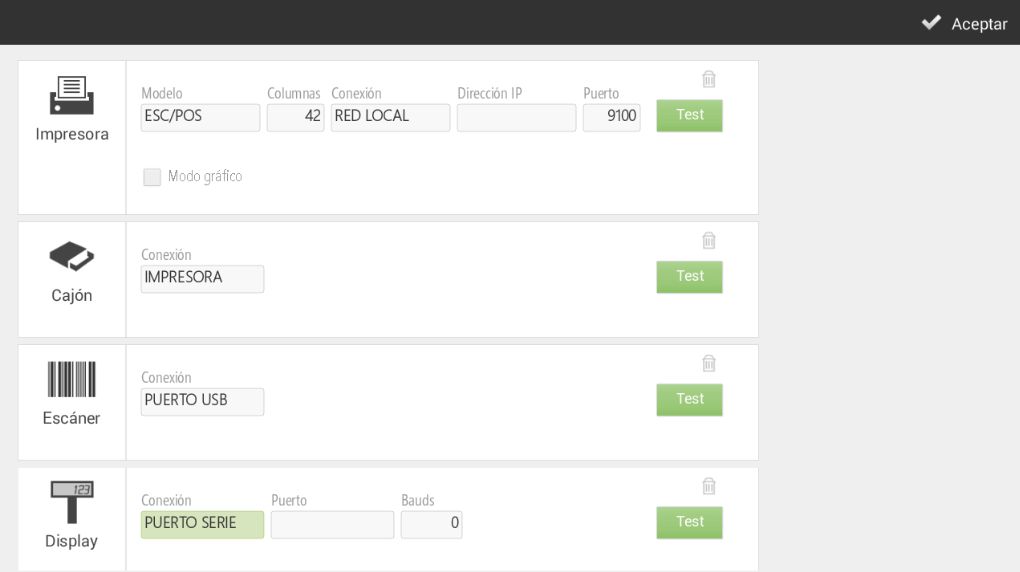
Once you have configured each device, press Test to test it and verify that it works correctly.
Depending on the device you are configuring, and the characteristics of your terminal, you will be able to select between different connections (Local network, Bluetooth, USB port, connected to the printer, Keyboard input, Serial port or Audio port).
If you wish to modify device settings or add a new device, you can do so in the Devices section of the screen Settings.
Printer
The printer we set up here will be the default printer the terminal uses for printing tickets.
HioPOS Cloud works correctly with most ticket printers compatible with ESC/POS. It is also compatible with ESC/POS* and WOOSIM models. You can also configure the number of columns of the printer. The most common is 42.
We can also configure the HIOPOS printer, which is characterized by playing a pre-configured sound every time a ticket is printed. Two default messages are provided: one that says, “Your ticket, thank you” and another that says “Heard, kitchen!” in different languages.
- 1-2: Spanish
- 3-4: English
- 5-6: Catalan
- 7-8: French
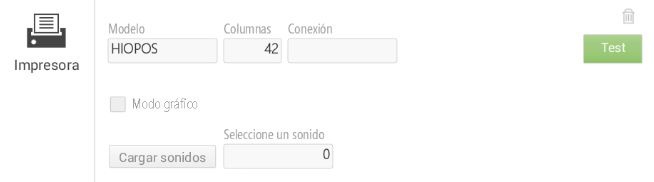
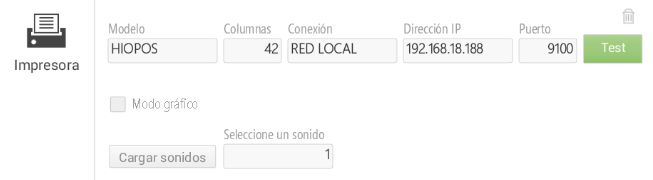
Next, we select the connection type. We can work on a Local Area Network, with Bluetooth, and with a USB Port.
If the printer is Ethernet, select Local Network and enter its IP address. By default, the port should be 9100.
If the printer is Wifi, we will select Local Network under Connection. In this case, it is important to note that both the printer and the point-of-sale terminal must be connected to the same Wifi network. We will enter the printer's IP address and port. Press Test to verify its operation.
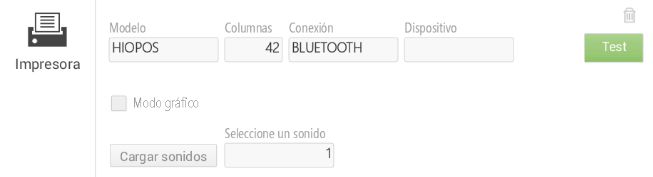
Selecting the Connection Regarding Bluetooth, we must keep in mind that the printer must be connected from the beginning with the Android operating system. To do this, go to the Android settings section and in the Bluetooth subsection, select the printer. Once correctly connected, we will return to HioPOS Cloud and select the Device that will already be automatically suggested to us. Press Test to verify its operation.
If we select the USB Port connection type, we need to have the printer connected to the USB port of the point-of-sale terminal or tablet. In the Device box, we select the port that HioPOS Cloud will already suggest by default. We click Test to verify its operation.
If we select the Serial Port connection type, we need to choose from the available ports. We will press Test to verify its functionality.
Cash drawer
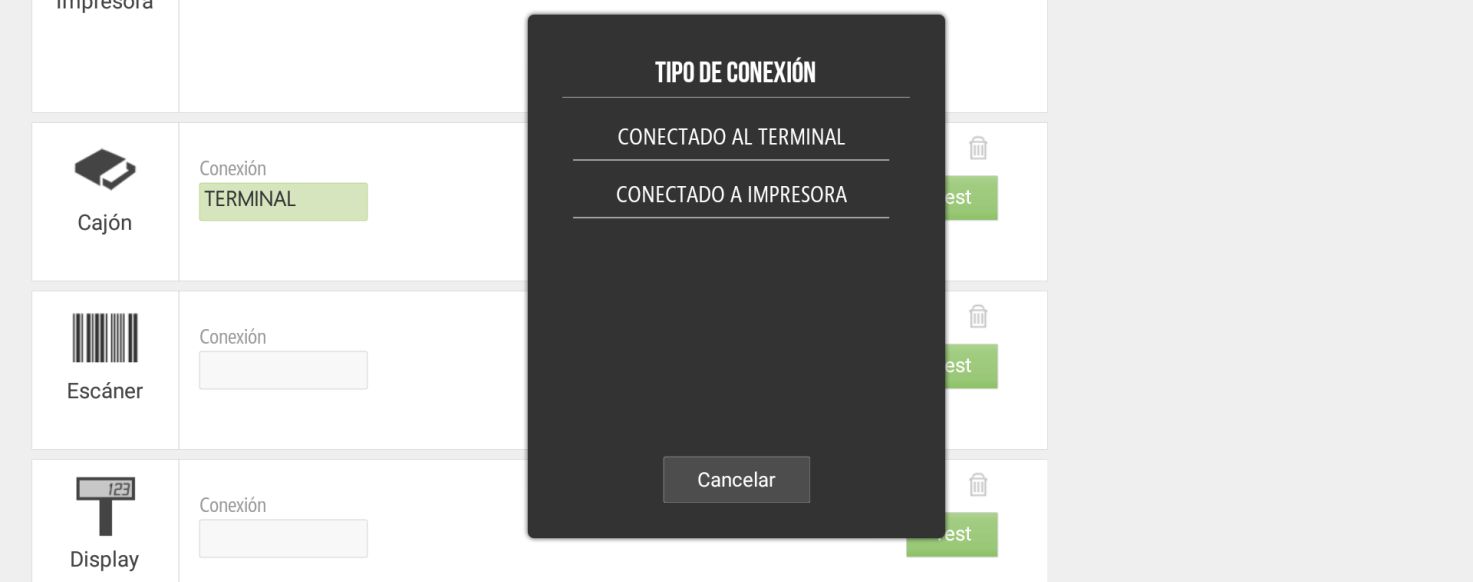
The cash drawer configuration can be performed by connecting it to the printer or to the terminal.
Scanner
The scanner, or barcode reader, can be used in three distinct modes: via Bluetooth, via USB Port, or via Keyboard Input.
When selecting the Bluetooth Connection, we must take into account that the scanner needs to be initially connected to the Android operating system. To do this, go to the Android settings section and in the Bluetooth sub-section, select the scanner. Once successfully connected, we will return to HioPOS Cloud and select the Device that will be automatically suggested. Press Test to verify its operation.

If we select the USB Port connection type, we need to have the scanner connected to the USB port of the point-of-sale terminal. In the Device box, we select the port that HioPOS Cloud will already suggest by default. Click Test to check its operation.

Keyboard input does not need any device connected to the point of sale. Simply type the product's barcode on the sales screen's numeric keypad, then press Enter. HioPOS Cloud will add the item to the sales receipt.
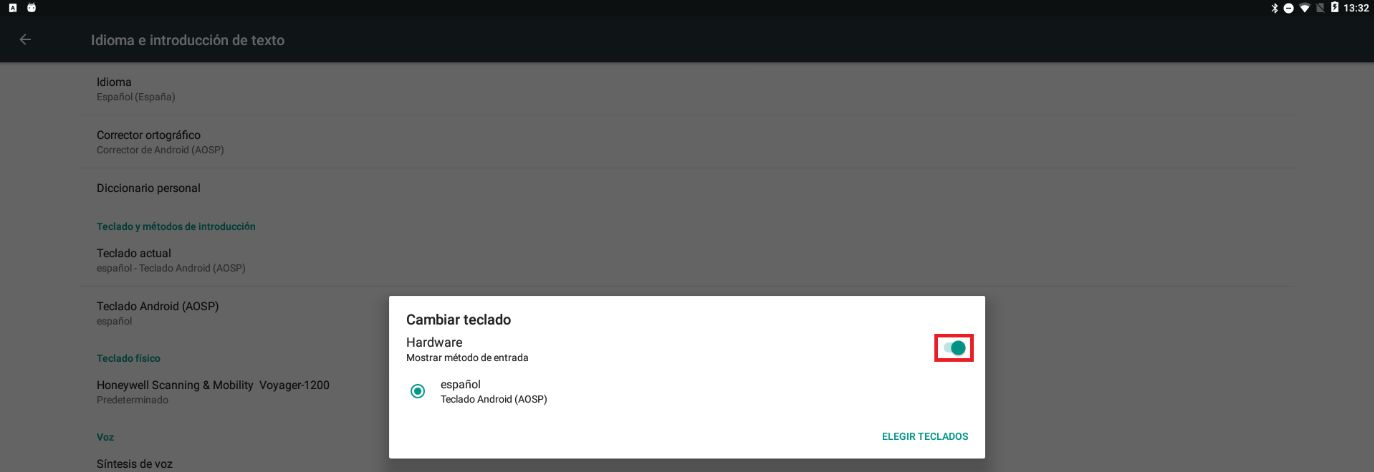
It is possible that when connecting the barcode reader to the terminal, the Android keyboard is disabled. To do this, you will need to go to the Settings specific to the Android device, Language and text input, in the section of Keyboard and input methods: Current keyboard, you will have to activate the option to Hardware: display input methods.
Display
We will select the client viewer model, as well as the type of configuration it has. The connection is via serial port.

Magnetic stripe reader
On a tablet, the magnetic stripe reader works by connecting to the USB port. Connect the device to the USB input and select Keyboard Emulation Connection. Press Test to verify its operation.

Label printer
The label printer we configured here will be the printer the terminal uses for label printing.
HioPOS Cloud works correctly with most label printers compatible with EPL or ZPL. The Connection can be done via Local Area Network, Bluetooth, USB port or Serial port.

Scale
The scale we configured here will be the scale the terminal uses to weigh those items configured by weight.
HioPOS Cloud works correctly with most Exa model scales and with the rest of the Generic models. The connection is made via Serial Port. For the connection port, you can choose between the 4 COM ports integrated into the HioPOS Cloud terminal.
When we press Test, the scale configuration window appears.

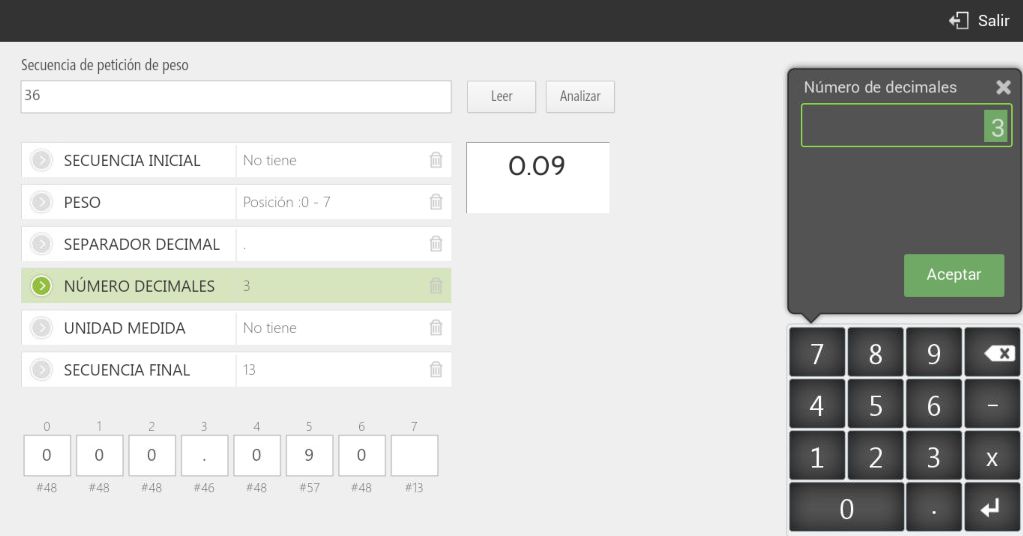
We will need to configure the Weight Request Sequence. This value usually appears on the front of the scale, followed by the acronym (S.P.). In our case, 36.
We can configure the position of the initial sequence, the weight positions, the type of decimal separator, the number of decimal places we want to use, the unit of measurement, and the position of the final sequence.
To verify that the configuration has been performed correctly, we press read and it should display on screen the same weight that appears on the scale itself.
One of the possible settings is the number of decimal places, as shown in the following image, we can select the number of decimal places we read on the scale.
AI Assistant
Section summary
AI can generate inaccurate information; verify the results.