En esta sección
Cost breakdowns with stock
To conclude with the format articles, we will focus on cost breakdowns with stock. If a cost breakdown USA STOCK said item will be manufactured And as a general rule, it will not be purchased; what should be purchased are its components. On the contrary, if NO USA STOCK, the sale will deduct stock from the components; additionally, the components must be purchased or manufactured to increase their stock.
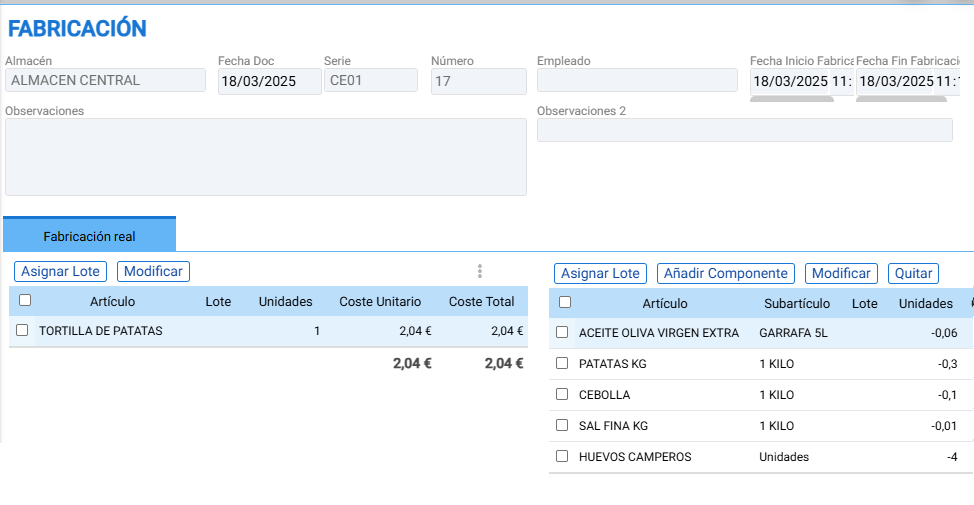
Therefore, following the example of the Spanish omelette article, let's imagine that now it's going to use stock, since we manufacture them and accumulate stock in our warehouse to then distribute vacuum-packed tortillas.
Therefore, the production of 1 unit of potato omelette will consume:
- 300 grams (0.3 kilos of potatoes)
- 300ml of oil, which in proportion to the 5l reference format, will be (0.06 5l bottles)
- 100g of onion (0.1 Kilos)
- 10g of salt (0.01 kg)
- 4 eggs (4 units)
Another configuration option that Hioffice offers us with bill of materials type items is the possibility to configure various levels of cost breakdowns. In other words, a cost breakdown as a component of another item that is also a cost breakdown.
Configuring items in this way allows for detailed inventory tracking, but incorrect configuration of item formats and units of measurement can lead to undesirable behaviors such as inventory and cost distortions. Therefore, before opting to configure items with this level of detail, we will verify that all components have their format and units of measurement correctly defined by applying the configuration options we have detailed in this document.
Example of a recipe costing within another recipe costing: We have the item "Capricious Salad" which is a "recipe costing" item and "DOES NOT use stock". Its sales format is "units". We always sell 1 unit of the salad dish by default.
It consists of the following articles:
- 100g of lettuce
- 200g of tomato
- 5ml of oil
- 50 ml of cocktail sauce (the latter is also a costing item)
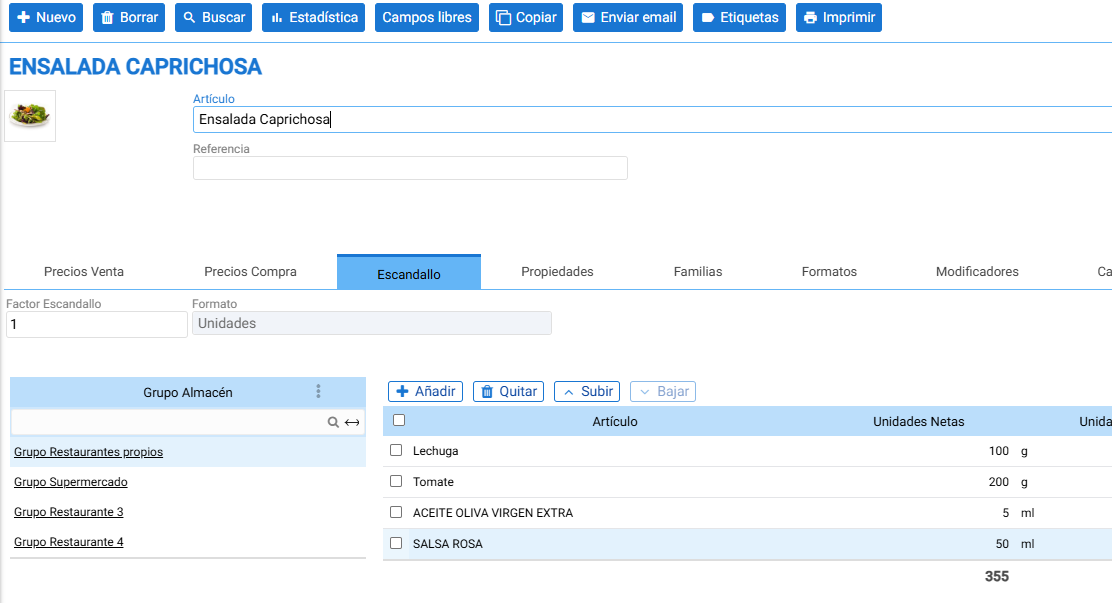
The reference format for Cocktail Sauce is "Liters", so when adding it as a component, we have changed the unit of measurement to "ml" and thus we can set 50ml. This way we don't have to use decimals.
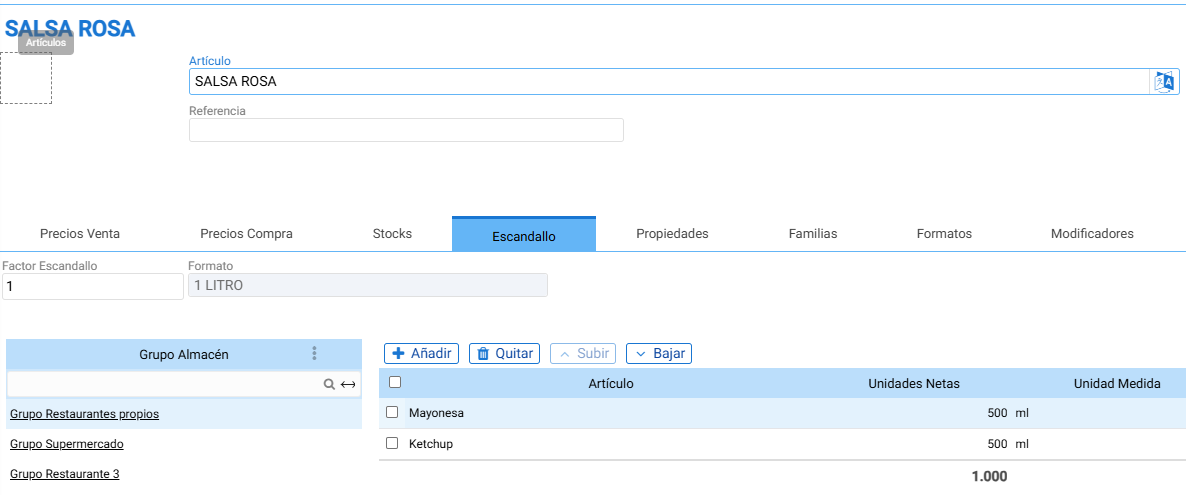
Pink sauce is a standard cost item that "Uses stock". Therefore, it means that we manufacture it. To manufacture 1 liter of sauce, we use 500 ml of Mayonnaise and 500 ml of Ketchup.
Example:
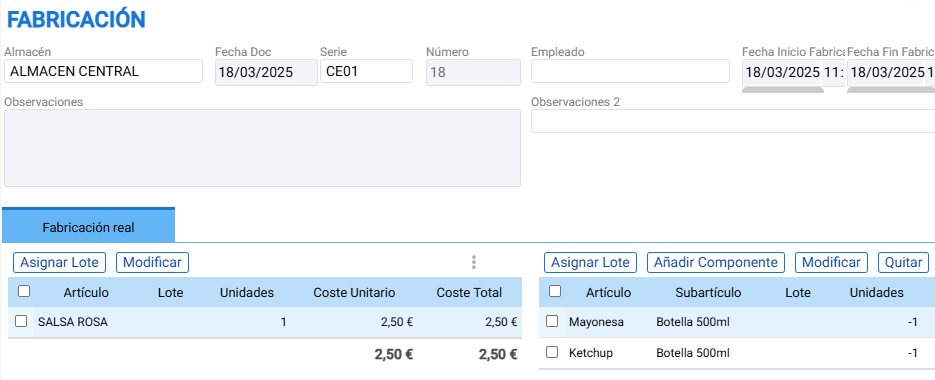
Both items (mayonnaise and ketchup) have a single reference format configured, which is a 500ml bottle. Therefore, the stock variation for manufacturing 1 liter of sauce will be one 500ml bottle for each of them.
Once manufactured, if we check the stock of the pink sauce, it will be 1 Liter:
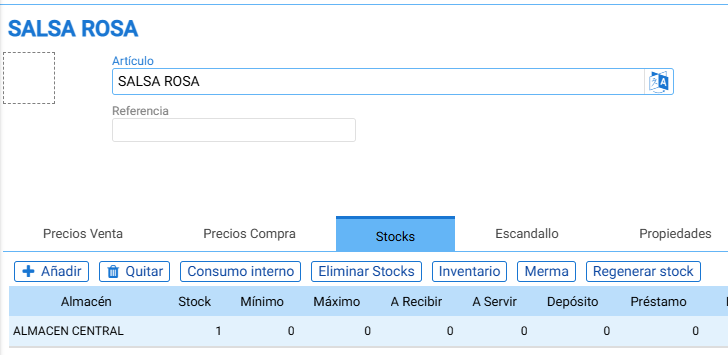
Now, we are going to proceed with the sale of 1 salad plate which will de-stock 50ml of pink sauce (0.05 liters). Let's see the example:
We access the stock tracking for "Pink Sauce"

We had 1 stock unit (1 liter) from manufacturing. Now, with the sale of 1 Salad, we see that it has generated a stock variation of -0.05 liters. 50 ml / 1000ml (1 liter) = 0.05 Liters.
AI Assistant
Section summary
AI can generate inaccurate information; verify the results.