En esta sección
Recalculation of costs
The operations that affect costs are purchases, stock movements, and cost adjustments.
The program has internal tools that automatically recalculate the cost of current stock whenever a modification is made to the purchase price of an already finalized document or a change occurs in the stock units that existed on a specific date. This function allows the user to enter purchases and modify amounts without throwing off the sales margin.
The stock cost displayed by the program is the WAP (Weighted Average Price) calculation of the price of the new purchase multiplied by the units purchased, added to the product of the last stock cost at that time multiplied by the total units available prior to the new purchase, and finally divided by the total stock units remaining.

If a backdated purchase is inserted, the automatic recalculation performed by the program will cascade for all operations affecting stock and costs subsequent to that purchase. In other words, the item's stock cost value will vary for all records saved from the modification until the present, or until a cost adjustment record is encountered.
Exceptions:
- Costing without stockA composite item calculates the margin based on the sum of the costs of all its component items.
- Sales before first purchase: In the event that sales of an item are made before any purchase is recorded, the stock cost will be zero, but the moment a purchase of the item is generated, the program will automatically insert the cost amount into the sales that had occurred.
If after inserting a purchase of the ingredients, the stock cost of one of them changes, the kit will automatically be refreshed.
The time it takes the program to perform this recalculation varies depending on the number of records and the age of the change being made.
Cost adjustment:
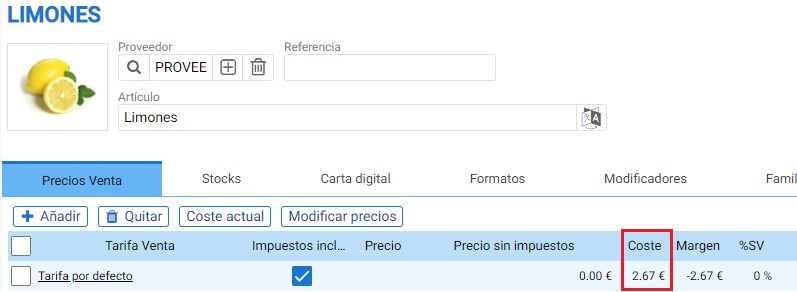
With the [Adjust Cost] tool, located on the item card (Sales Prices tab), a Cost Adjustment is generated on the specified date. This option modifies the item's margins and is useful for recalculating the costs of an item that has an incorrect price for one or more purchases.
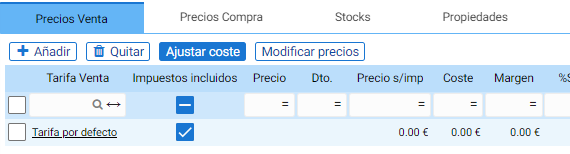
As soon as a cost adjustment is inserted on a date, the program blocks the cascading update at that point, as this process sets a new value for a specific day and is not variable.
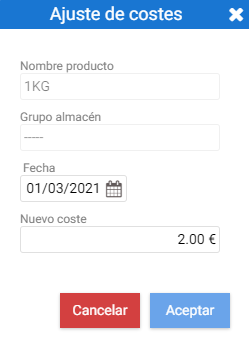
Clicking the button opens a pop-up window with the [Date] and [New cost] fields.
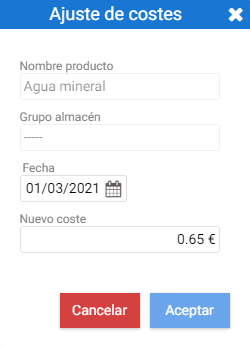
The date on which the cost adjustment is to be applied and the amount must be indicated. Upon accepting and refreshing the item's record, the change made will be visible.
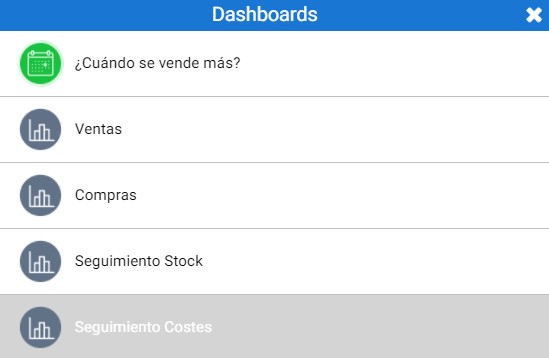
To view the record of this operation, you must go to the item card header and access [Statistics – Cost Tracking]. In this report, you can view the Cost Adjustment document generated between purchases. We distinguish it by its series, and it is also a document without an associated contact. This document does not affect the item's stock, as the calculated units are fictitious.

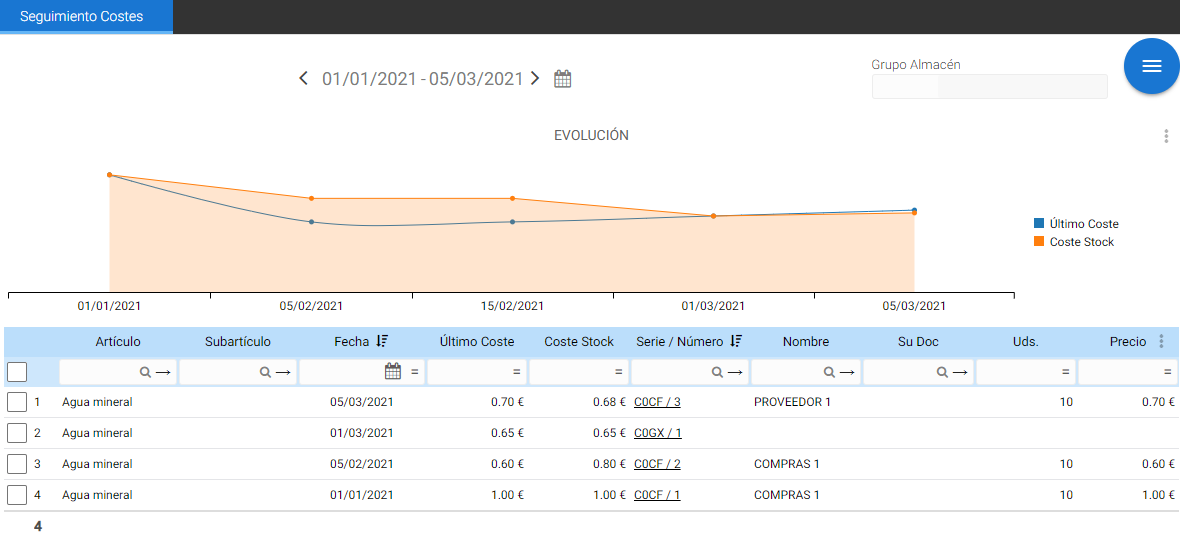
Example: Cost recalculation in the bill of materials:
The item Lemonade is composed of 50g of lemons and 1 unit of mineral water.
The calculation of the cost of ingredients is the cost of the format divided by the units and exchange rate for the component's unit of measure.

This way, 50 grams of lemons are €0.13 and, added to the bottle of water, make a total of €0.81 in total cost for the Lemonade item.

Performing a cost adjustment for the item lemons on March 1st, and indicating that the kg cost €2, the total cost of the lemons will be recalculated.

Since the cost of lemons has been modified, the cost of the Lemonade costing also changes:

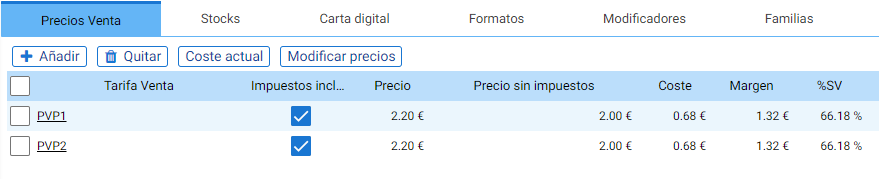
The change is also reflected in the margins of the lemonade:

To see how the program calculated the cost for lemons, the following article shows the record of purchases made before and after the adjustment, as well as the adjustment itself.
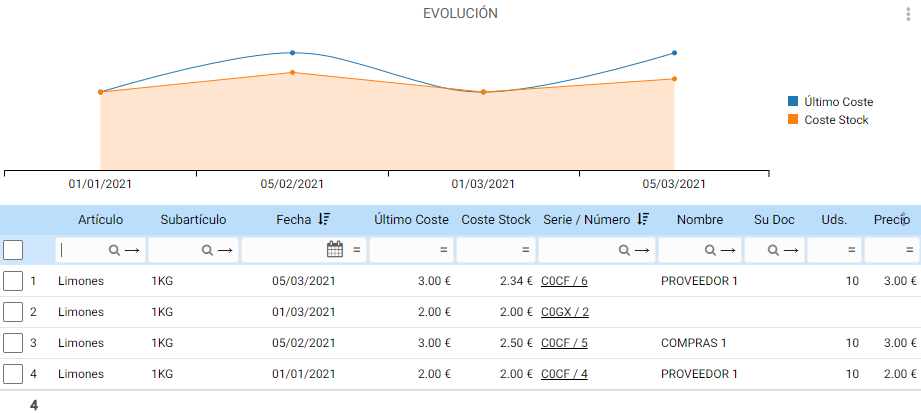
The follow-up shows how the stock cost amount was modified in the purchase subsequent to this adjustment and has changed to €2.34.
Before the adjustment, the item had a record of two purchases of 10 bags of 1 kg each and one sale of five units of lemonade, so that on March 1st, the actual stock of lemons was 19.25.
The calculation performed by the program is this:

AI Assistant
Section summary
AI can generate inaccurate information; verify the results.